
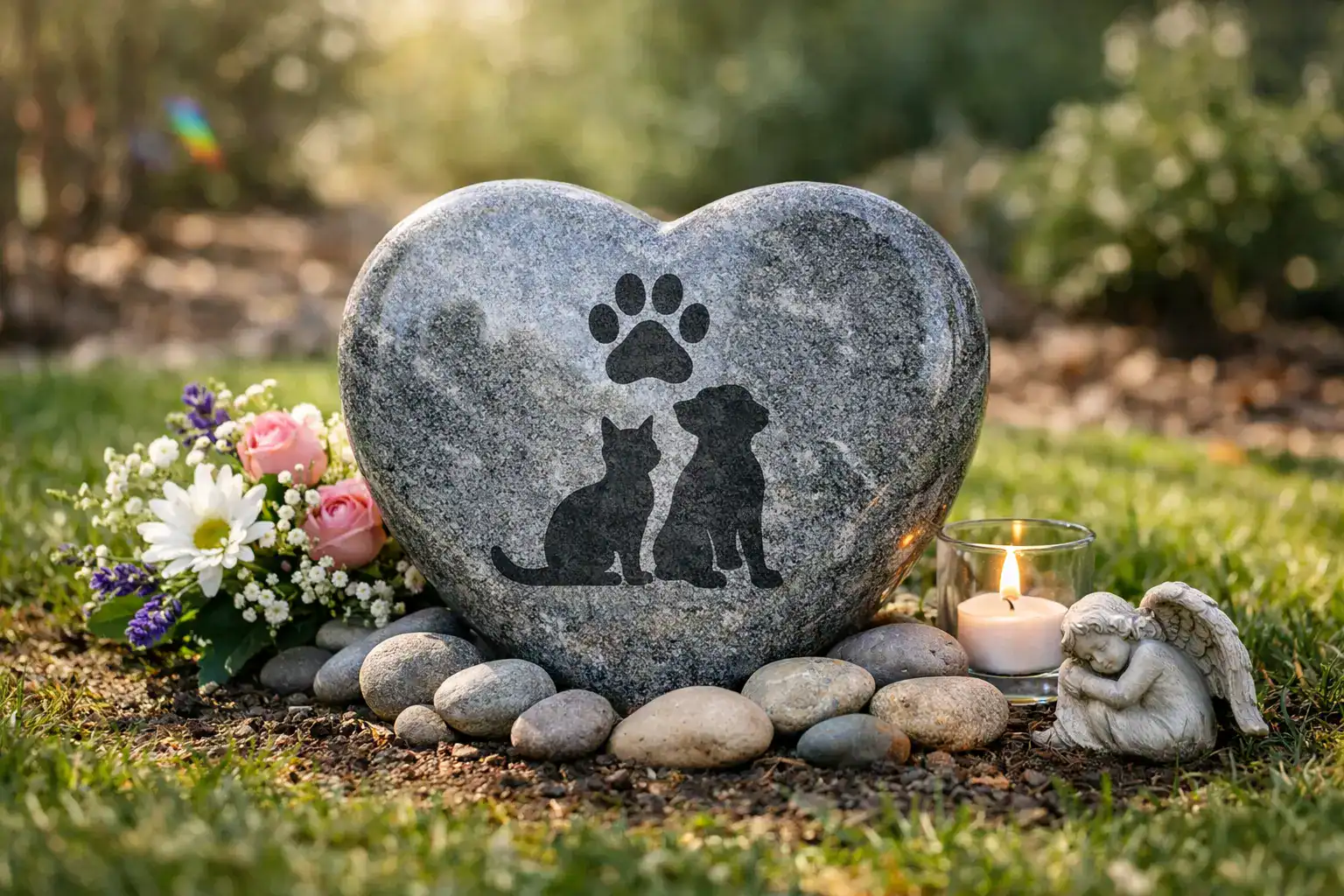
Some spots choose themselves.
The patch beneath the maple tree. The corner of the garden where they used to stretch out in the afternoon sun. The path your cat surveyed from the window like it was hers to rule.
You probably already know the spot. You might have walked past it a dozen times since they were gone, without quite being able to look at it directly. Or maybe you’ve found yourself standing there, not sure why you stopped.
That place is already theirs.
What you put there should feel worthy of it.
Not decorative. Not something that looks fine in the first season and starts to fade by the second. Something that holds. Something that still looks like a memorial ten winters from now, not like something that got left outside and forgotten.
If you’re reading this, you’re probably trying to figure out what that looks like. What the right choice is. Whether granite is really better, whether the photo will work, whether the words have to be perfect.
This page will walk you through all of it.
Why grief makes you want something solid
There’s something that happens after you lose a pet.
You keep looking for them. Not on purpose. You just do. In the kitchen, when you reach down out of habit. At the door, when you come home. In the garden, in the spot they always claimed.
And there’s a particular kind of ache that comes from a place being just… empty.
Nothing marks it. Nothing says: something happened here. Someone lived here. Someone was loved here.
That’s what a memorial does. Not in a dramatic way. Not in a way that’s supposed to fix the grief or give it a tidy ending. It just gives the place a presence. Something solid that says, yes — they were here.
I understand that feeling personally.
My name is Jean Cote. I’m the founder of Furever Memorials. I lost my two dogs, Onyx and Chase, a few years apart. And both times, I found myself wanting something for the garden. Something I could walk past every morning. Something that didn’t ask the world to slow down, but quietly held its ground anyway.
I couldn’t find what I was looking for. So eventually, I made it.
That’s the whole reason this company exists.
Why the material matters more than you might expect
The first instinct, when you start looking at memorials, is usually to keep costs down.
That makes complete sense. You’re not in a clear-headed shopping mindset. You’re grieving. You just want to do something. And when you see that a resin stone or a ceramic plaque costs a fraction of the price, it’s tempting.
But here’s what I’ve seen happen, and what I’d want someone to tell me before I made that choice.
Outdoor conditions are harder than they look.
In Canada especially, the freeze-thaw cycle is relentless. Every winter, water finds tiny weaknesses in a material — a small crack, a rough edge, a porous surface. It gets in. It freezes. It expands. Come spring, the material is a little worse than it was. Repeat that for a few winters and you start to see the damage.
Wood warps and splits. Ceramic cracks. Printed finishes soften and peel. Surface etchings lose their sharpness. Even some softer stones — marketed as garden-safe — start to blur over time.
A memorial that fades is a particular kind of hurt. You’ve already grieved the loss of your pet. You shouldn’t have to grieve the loss of their memorial too.
The right material doesn’t ask time to be gentle with it.
It just holds.
Why granite is the right choice for outdoor memorials
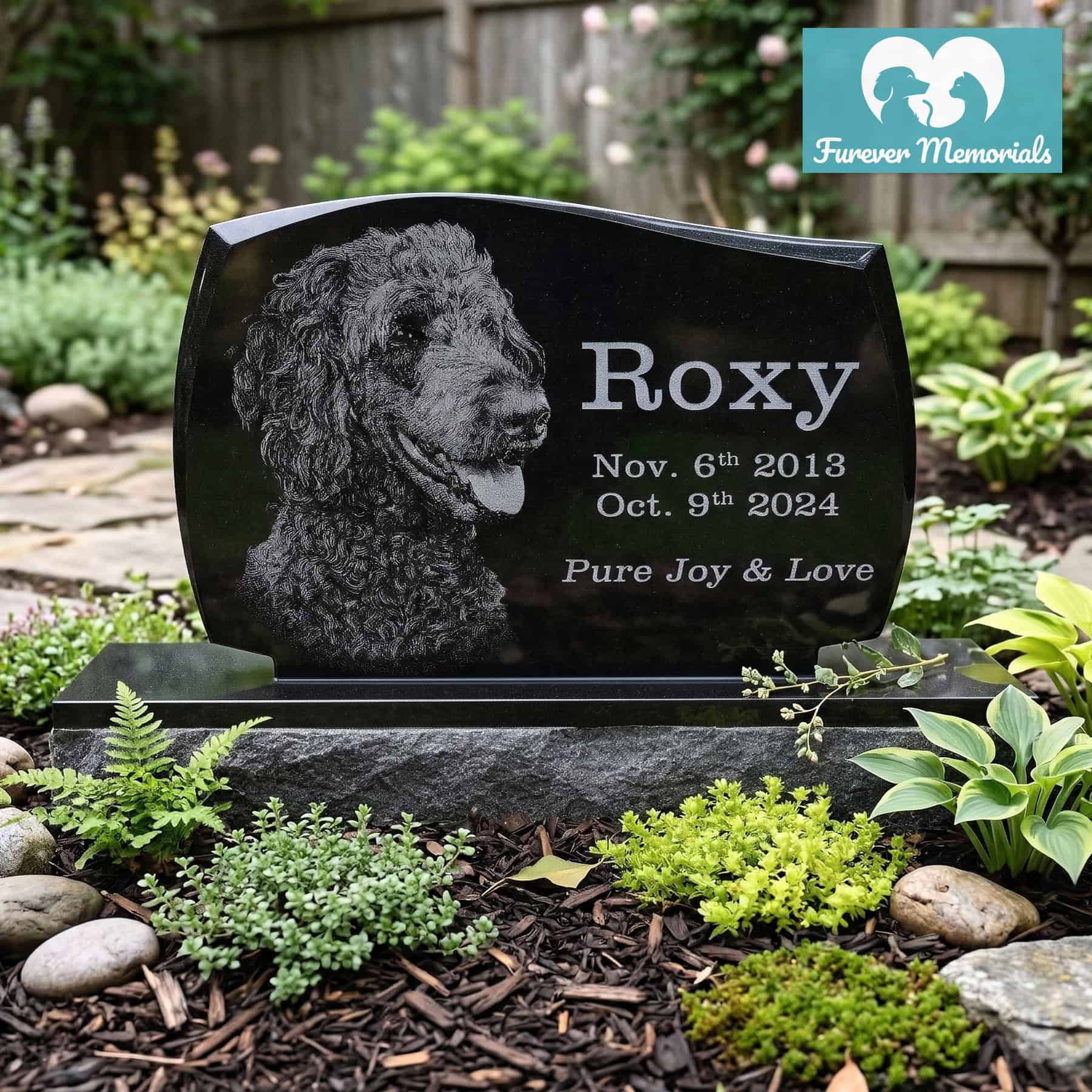
For anything that’s going to live outside year-round, through Canadian winters and summer heat and everything in between, premium granite is in a different category from everything else.
It’s dense. It doesn’t absorb water the way softer or porous materials do. It doesn’t warp. It doesn’t crack in frost. It doesn’t lose its surface to UV exposure. Cemetery-grade granite is the same material that has been used in graveyards for over a century — because it works, and because it lasts.
There’s also something about the weight and presence of a real granite stone that you notice immediately. It doesn’t feel like a garden ornament. It feels like what it is.
Thickness matters too. A 2-inch-thick granite memorial sits with a solidity that thinner pieces simply don’t have. You set it down and it’s there. It belongs. It doesn’t tip in the wind or look like it might crack if someone trips on it.
That’s not just aesthetics. It’s the difference between a memorial that you trust and one that quietly makes you worry.
What to put on it
This is the part that trips people up most.
There’s no pressure to get this perfect. There is no perfect. There’s just what’s true.
A name is the anchor. It’s the one thing you won’t regret including, no matter what else you decide.
Dates matter to some families. They give the stone a sense of a life lived — a beginning and an end — and for some people that feels right and complete. Others prefer not to include them. Some find the numbers too clinical, or too final. Neither approach is better. It’s whatever feels good to you.
Inscriptions are worth thinking about carefully, not because they need to be poetic, but because shorter usually hits harder.
Best friend. Forever loved. Good boy. She knew.
You’re not trying to summarize a life in a sentence. You’re just placing a small, true thing next to their name. If it’s real, it doesn’t need to be elaborate.
Some people agonize over the wording for weeks. Others know instantly. Both are normal. If you can’t decide, sit with it for a few days. The right words usually find their way to the surface.
Photographs on stone
Many people hesitate at this step.
They’re worried the photo won’t translate well. That it’ll look blurry, or dark, or nothing like the original. That they’ll choose a picture that doesn’t do justice to the face they loved.
It’s a fair concern. Not every engraver handles photos the same way, and the quality really does vary.
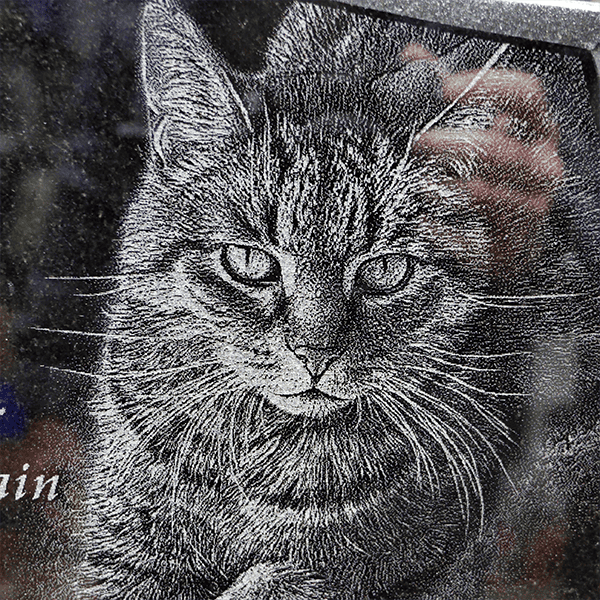
When it’s done well, the result is something quieter and more lasting than a print. It’s not a glossy photo copy. It’s a likeness interpreted through stone. The detail is there — the expression, the eyes, the particular way they held their head — but it has a permanence that no printed image can match.
Choosing the right photo matters.
For most dogs and cats, a clear, well-lit photo taken from the front or a slight angle works best. The face should be the focus, not cropped too tightly. Natural light tends to give better results than flash. If you have multiple photos you’re considering, it’s worth getting guidance on which one will engrave most clearly — a good memorial maker can tell you before anything is finalised.
You’ll see a proof before the stone is made. That step matters. Look at it carefully. Make sure the placement feels right, that the photo has the clarity you expected, that the text is exactly as you want it. Changes at that stage cost nothing. Changes after the stone is cut are another matter.
The three styles — and how to choose
There’s no single right format. There’s just the one that fits the space and the pet.
Flat pet memorial stones work well in garden beds, dedicated burial spots, and quiet corners where you want something low and grounded. They sit close to the earth. They feel understated. Peaceful, without drawing too much attention to themselves.
They also make practical sense in spaces where an upright marker would look too formal, or where you want the memorial to feel like part of the garden rather than a monument in it.
Upright pet headstones create more of a focal point. For some families, that’s exactly what they want — a clear, visible marker that gives the space its purpose. Something you can see from the back step. Something that says, plainly, that this is a place of remembrance.
If the memorial is marking a dedicated resting place, an upright stone often feels most fitting. It has the weight and presence of a traditional headstone, and some people find that comforting. It turns a corner of the garden into something intentional.
Boulder style pet memorials sit differently in a landscape. They feel organic, like they’ve always belonged there. Less formal. Still made from real stone, still built to last — but shaped in a way that settles into a garden bed rather than standing apart from it.
This style often appeals to people who want the durability and permanence of granite, but prefer something that doesn’t look like a traditional marker. A dog who loved to dig in the flowerbeds might call for something different from a formal headstone. A cat who claimed the garden as her own might suit a stone that looks like it grew there.
The best choice depends on the space, and on the pet.
A lively, muddy, sock-stealing dog probably calls for something different from a quiet old cat who spent her days watching the birds from the windowsill.
There’s no wrong answer. There’s just the one that feels right when you imagine walking past it.
A note on price and permanence
It’s completely understandable to compare prices. You’re making this decision at an emotional moment, often without much time to research, and there’s a wide range of options out there.
But with outdoor memorials, lower cost almost always means something.
Thinner stone. Shallower engraving. Less durable material. Sometimes a combination of all three.
That doesn’t mean you need the largest or most elaborate stone available. It means the cheapest option can become the most expensive one if it fades, chips, or breaks and needs replacing. For a lot of people, there’s real comfort in choosing once and choosing well — knowing the memorial you put in the garden this year will still be there, clear and dignified, a decade from now.
A premium memorial isn’t only about how it looks. It’s about not having to wonder, every spring after a hard winter, whether it survived.
What the process looks like
Ordering a custom stone can feel daunting when your emotions are still close to the surface. In practice, it doesn’t need to be complicated.
You start by choosing the style and size. Then you provide your pet’s name, dates, the inscription you want, and a photograph if you’d like one included.
From there, a design proof shows you exactly how everything will look before any engraving begins. This is an important step. Take your time with it. Review the layout, the text, the image placement. If something doesn’t feel right, say so. That’s what the proof is for.
Once you approve it, the stone is engraved and prepared for delivery.
At Furever Memorials, every stone is made from cemetery-grade black granite, with deep diamond-impact engraving that doesn’t fade. The process is built to be clear, unhurried, and careful — because this is not a transaction. It’s something you’re trusting us to get right.
We also understand that not everyone is ready at the same moment. If you’re not sure yet, that’s fine. There’s no rush. Whenever you’re ready, we’re here.
The spot deserves something that lasts
There’s a quiet reassurance in stepping into the garden after the first hard winter and seeing the stone exactly as it should be.
The name still crisp. The image still clear. The inscription still readable, exactly as you wrote it.
It hasn’t asked time to be gentle with it. It was made to endure.
That’s what an outdoor memorial is really about. Not just marking a place. Not just having something to look at when you miss them.
It’s about knowing that the tribute you placed in the garden will still be there in five years, in ten, in twenty. That the face engraved in the stone is still their face. That the name is still their name.
They were here. They were loved.
And that doesn’t stop.
