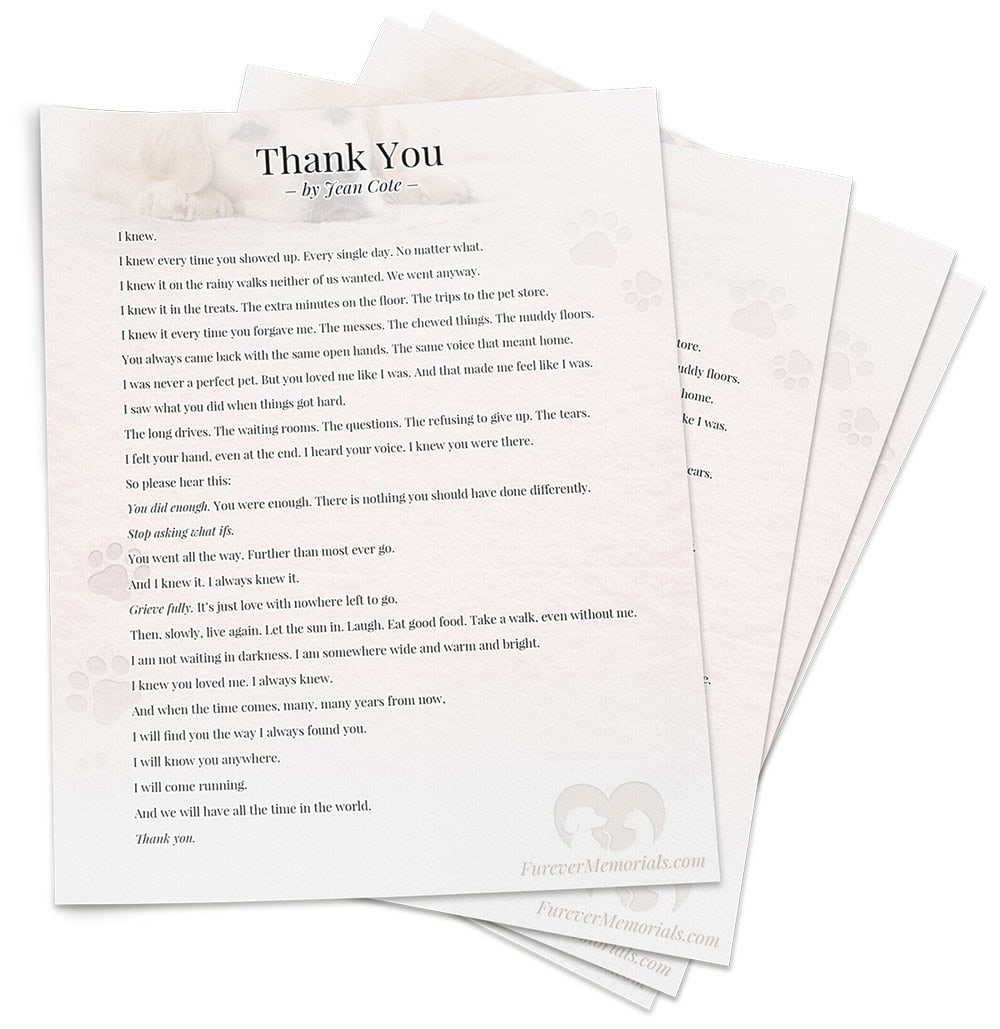
I wrote something for you. A small poem about where they might be now. You can find it at the end of this page.
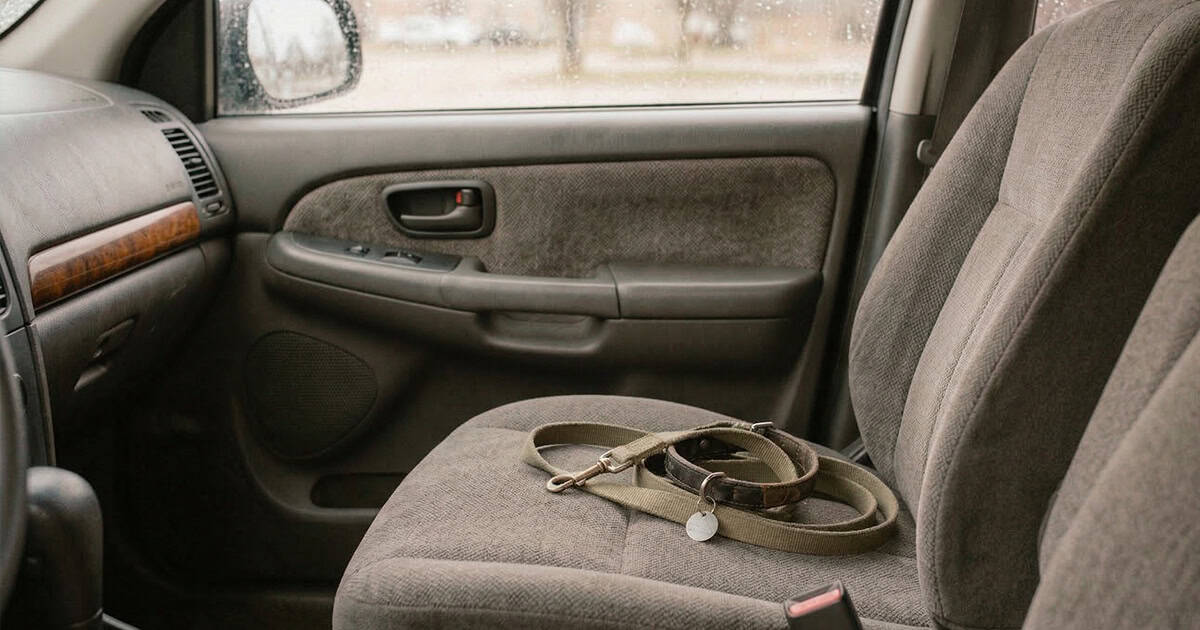
You carried their leash home.
Maybe it was in a plastic bag. Maybe you just held it in your hand. Either way, you walked to your car, sat down, and something inside you broke open.
They didn’t walk out with you.
If you’re reading this, you already know the kind of pain I’m talking about. It doesn’t arrive all at once. It ambushes you. In the kitchen, when you reach down out of habit. In the morning, when your feet hit the floor and you almost call their name. In the evening, when the house gets quiet in a way it never used to.
That quiet is the hardest part.
Not silence exactly. An absence. The specific, irreplaceable absence of the one living thing that knew your routines better than anyone.
You might be wondering when it gets easier. You might be wondering if something is wrong with you. Maybe someone has already said “it was just a dog” or “you can always get another one.” And maybe you felt a flash of anger so sharp it surprised you.
Nothing about what you’re feeling is wrong.
Not one single part of it.
This is grief. Real, legitimate, profound grief. And it deserves to be taken seriously.
The Moment You Walked Back Into Your House
There’s a moment almost everyone describes the same way.
You come home. You open the door. And the house is wrong.
Not wrong in a big, dramatic way. Wrong in a quiet way you can’t quite explain. Their bed is still there. Their bowl is still on the floor. The dent in the couch cushion is still shaped like them.
Everything is exactly where it should be.
Except for the one thing that made any of it matter.
I know this feeling personally.
My name is Jean Cote. I’m the founder of Furever Memorials. And I lost my two dogs, Onyx and Chase, a few years apart. Each loss hit me in a way I wasn’t fully prepared for, even after watching them age and knowing the end was coming.
Chase was a red and white Border Collie. Full of energy and drive, even when her body started fighting against her. Her first symptom was a chronic cough that slowly stole her ability to play hard. And that was the part that broke my heart. Because she desperately wanted to. You could see it in her eyes every single day. The willingness was always there. Her body just wouldn’t let her.
We went from vet to vet looking for answers. Regular vets. Holistic vets. Nobody could tell us what was wrong. The cough never went away. The mucus never stopped. Eventually I started cooking her meals myself. Fresh chicken breasts and rice every night, because I wanted to give her every possible advantage. She ate better than most people.
It still wasn’t enough.
Onyx was a black and white Siberian Husky. Her decline came through her legs. Arthritis that slowly, steadily stole her strength over many years. I managed it with pain medication, but I could see it wasn’t enough. I remember watching her get stuck in the snow in the backyard, her hind legs just giving out beneath her. So I got her a wheelchair.
She only got to use it for two or three weeks.
Near the end, she stopped eating. That hit differently than anything else. Onyx had always loved her food. So I went out and bought four different kinds of wet dog food, the ones she used to go absolutely crazy for. I set them all in front of her, one by one.
She didn’t touch any of them.
Two days later, she was gone.
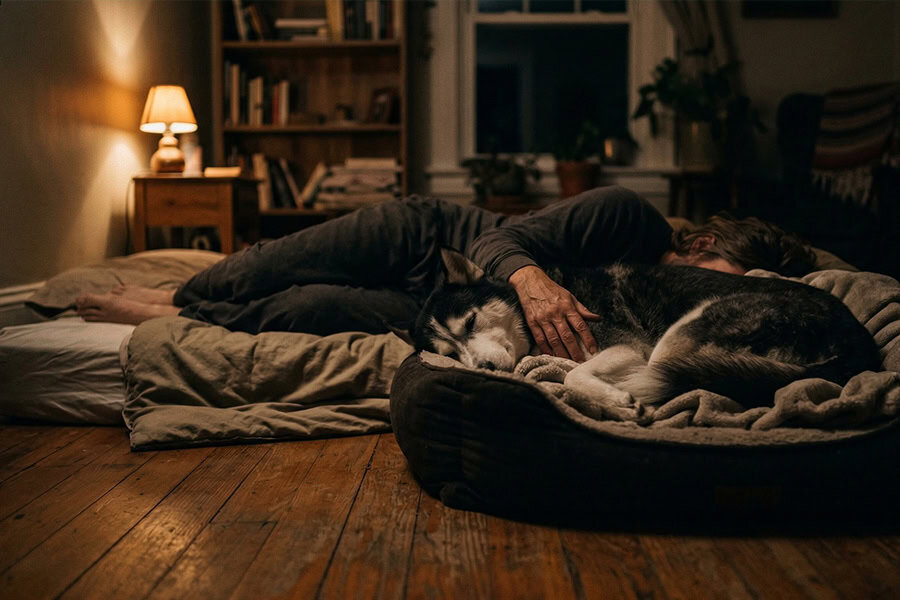
But the night before she passed, I knew. I don’t know exactly how. You just know, when you’ve loved an animal for that long. She was curled up in her bed and something told me this was it. The vet was closed. It was a weekend and there was nothing I could do but be there.
So I dragged my mattress next to her bed.
I lay beside her all night, petting her, talking to her quietly. And in her final moments, I told her that I loved her. That I was so grateful for every single day we had shared together.
That is the last thing she heard.
I’m glad it was that.
Why This Grief Catches People Off Guard
Most of us were prepared, in some way, for human loss.
We watched grandparents age. We were taught, however awkwardly, that people die. Society has built a scaffolding around human grief. Language for it. Time set aside for it. Permission to fall apart.
Pet loss has almost none of that.
There’s no bereavement leave. Often no funeral. The world just keeps going. And you’re left grieving something enormous while everything around you stays completely the same.
That gap, between how much it hurts and how little the world acknowledges it, is one of the cruelest parts.
But here’s what research actually tells us. The bond between a person and their pet can be just as strong as many human relationships. Studies have found that pet owners who lose their animals show the same grief responses as those who lose a close family member. The same stress markers. The same psychological impact.
The grief is real because the bond was real.
It’s that simple.

They Were Woven Into Everything
Losing a pet doesn’t just remove one relationship from your life.
It unravels an entire fabric of daily living.
Think about how many moments of your day they were part of. The alarm goes off and the first thing you do is acknowledge them. A pat, a word, their tail already moving before you’ve fully woken up. You go downstairs and they follow. You make coffee and they wait. You eat and they watch, hopeful, patient, completely shameless about it.
You leave and they’re at the door.
You come home and no matter how the day went, they act like your return is the greatest thing that has ever happened.
That rhythm, repeated thousands of times over years, becomes part of who you are.
And then it stops.
Grief researchers call this grief overload. It’s not just one loss. It’s dozens of small losses happening all at once. Every routine that included them is now a reminder. Every habit you built around them is now a door that opens onto absence.
The morning walk. The evening feeding. The way you moved to the other side of the couch to give them their spot. The sound of their nails on the hardwood floor, which you thought you’d never take for granted, but maybe you did a little, and now you’d give anything to hear it one more time.
This is why it feels so relentless in those first weeks.
It’s not one loss. It’s a hundred small losses every single day.
The What-Ifs
There’s something else that comes with losing a pet. Something people rarely say out loud.
The what-ifs.
What if I had taken her to the vet sooner. What if I had tried a different treatment. What if I had caught the signs earlier. What if I had been there more. What if I had chosen differently at the end.
This is one of the most painful and least talked about parts of grief. Because with our pets, we are often the ones making the decisions. We choose the treatments. We choose the timing. We carry that weight long after they’re gone.
The mind, in its grief, will replay those choices endlessly. Looking for the mistake. Looking for the thing that might have changed the outcome.
But here is what I’ve come to understand, through losing my own dogs and through years of walking alongside families in their grief.
We are not in control of most of it.
We never were.
We can love them with everything we have. We can cook them fresh meals every night. We can drive hours to specialists and try every option available and sit helplessly through things we cannot fix. And still not be able to stop what is coming.
Life unfolds the way it unfolds. We don’t get to plan for every possibility. We don’t get to see around corners. None of us do.
All we can do is show up. Love them as fully as we know how, for as long as we have them, and accept that some things are simply out of our hands.
That is not failure. That is being human.
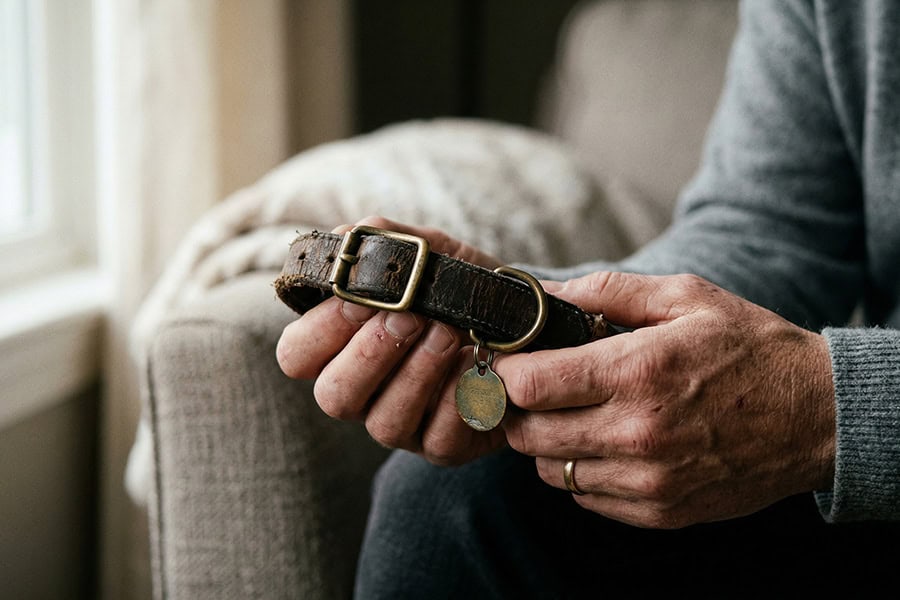
The what-ifs are grief talking. They feel real, but they are not the truth.
The truth is that they were loved. Completely, every day, in every way you knew how. And they felt every bit of it.
The Things People Say
At some point, most people encounter someone who doesn’t know what to say. And says the wrong thing anyway.
“You can always get another dog.”
“It’s not like losing a person.”
“At least they’re not suffering anymore.”
“Maybe it’s time to move on.”
These things are almost never said with cruelty. People reach for something because silence feels uncomfortable. But they land hard. Because they miss the entire point of what you’ve lost.
You didn’t lose a pet.
You lost a relationship. A presence. A living creature who knew your moods, your routines, your voice, your smell. Who loved you with a simplicity and a steadiness that is genuinely rare in a human life. Who never had a bad day aimed at you. Who never needed anything from you except your presence.
You don’t have to defend your grief to anyone. You don’t have to make it make sense to people who haven’t felt it. You don’t have to shrink it down to a size that makes others more comfortable.
It was a big love.
It deserves a big grief.
What Grief Actually Looks Like
Grief is not one emotion. It’s many, arriving out of order, often contradicting each other.
It can feel like sadness so heavy you can barely get off the couch.
It can feel like anger at the disease, at the timing, at anyone who doesn’t understand.
It can feel like relief, followed immediately by guilt for feeling relieved.
It can feel like numbness. A strange flatness that makes you wonder if something is broken in you.
It can feel like a physical ache. A reaching in your chest. A need to see them or touch them that your body doesn’t know how to stop doing yet.
It can feel like joy when a memory surfaces. And then a fresh wave of loss right behind it.
Some people cry constantly in those first weeks. Others don’t cry at all and wonder if they’re doing it wrong. Some people talk about their pet to everyone they meet. Others go quiet, keeping something too tender to share.
There is no right way to do this.
The only wrong way is to tell yourself you shouldn’t be feeling it at all.
There Is No Timeline
The world gets grief wrong in one important way.
It treats grief like something you move through. Stage by stage. Forward and forward until one day it’s over.
That’s not how it works.
Grief circles. It revisits. It can go quiet for weeks and then find you when you least expect it. A dog at the park that looks just like yours. A sound from another room. A toy found behind the couch you forgot was there.
This doesn’t mean you’re going backward.
It means you loved them. That’s all.
The intensity does ease over time. Not because you miss them less, but because you slowly build new rhythms. A new shape to your days. They don’t disappear from your life. They become part of the story of who you are.
What Helped Me
After losing Onyx and Chase, I needed to do something with all of it. The love. The grief. The gratitude for every year we had together.
For me, that meant creating a memorial. A piece of granite with their faces and their names, placed in my garden where I plant flowers every spring. When I tend to those flowers, I’m not trying to move on. I’m choosing to remember. And that choice brings me peace.
But I want to be honest with you.
A memorial isn’t for everyone. Some people find comfort in a simple photo on the mantle. Others plant a tree. Others keep a collar in a drawer and that’s enough. There is no right or wrong way to honour the animal you loved.
What matters is that you find something that feels true to you and to them.
I share this not to point you toward any particular choice. I share it because doing something, however small, gave my grief somewhere to go. And I hope you find that too, in whatever form feels right for you.
You Are Not Alone
What you’re feeling right now is shared by millions of people.
People who loved their animals the way you loved yours. People who carried a leash home and sat in their car and didn’t know how to go inside. People who woke up the next morning and had to learn all over again that their pet was gone.
People who still talk about them years later. Who still tear up. Who still reach down sometimes out of habit.
You are not too sensitive.
You are not overreacting.
You are not broken.
You are someone who loved deeply and honestly, for as long as you had them. And you are learning to carry that love in a new way.
Not gone. Just changed.
Give yourself the time you need. Talk about them. Share their photos. Tell the stories, the funny ones, the small ones, the ones only you would think to tell. Write down your memories while they’re still vivid.
They were here. They were loved.
And that doesn’t stop.
I wrote the poem below for anyone who has ever loved a dog and had to say goodbye.
It’s yours. Print it, keep it, share it with someone who needs it.
Thank You
I knew.
I knew every time you showed up. Every single day. No matter what.
I knew it on the rainy walks neither of us wanted. We went anyway.
I knew it in the treats. The extra minutes on the floor. The trips to the pet store.
I knew it every time you forgave me. The messes. The chewed things. The muddy floors.
You always came back with the same open hands. The same voice that meant home.
I was never a perfect pet. But you loved me like I was. And that made me feel like I was.
I saw what you did when things got hard.
The long drives. The waiting rooms. The questions. The refusing to give up. The tears.
I felt your hand, even at the end. I heard your voice. I knew you were there.
So please hear this:
You did enough. You were enough. There is nothing you should have done differently.
Stop asking what ifs.
You went all the way. Further than most ever go.
And I knew it. I always knew it.
Grieve fully. It’s just love with nowhere left to go.
Then, slowly, live again. Let the sun in. Laugh. Eat good food. Take a walk, even without me.
I am not waiting in darkness. I am somewhere wide and warm and bright.
I knew you loved me. I always knew.
And when the time comes, many, many years from now,
I will find you the way I always found you.
I will know you anywhere.
I will come running.
And we will have all the time in the world.
Thank you.
Keep this close, or share it with someone who needs it.
Download a beautifully designed printable version of this poem — something you can hold onto, revisit, or give to someone going through loss.
PDF • Letter size • Ready to print